Per Spotify, my most listened-to artist of 2025 was Jamie Paige, who was introduced to me that same year by the enormously fun and infinitely catchy “BIRDBRAIN,” a bonus track for the Deluxe Edition of the 2024 album Constant Companions. Paige’s music makes great use of Vocaloid, the voice synthesizer made familiar to general audiences by way of the anime-style virtual singer Hatsune Miku. I had a prior, passive understanding of Vocaloid, but had never made any effort to seek out this music or figure the phenomenon of Vocaloid out in any real way. It’s entirely to Paige’s credit that I could be made to instantly see the virtue and expressive potential of Vocaloid. And yeah, in large part it’s because Paige has a great ability for immediate melodies that would be powerful in any form they were presented, but the music is also about Vocaloid in a way that can be cogently written about and couched in the topics of artist identity that have been my concern in recent articles.
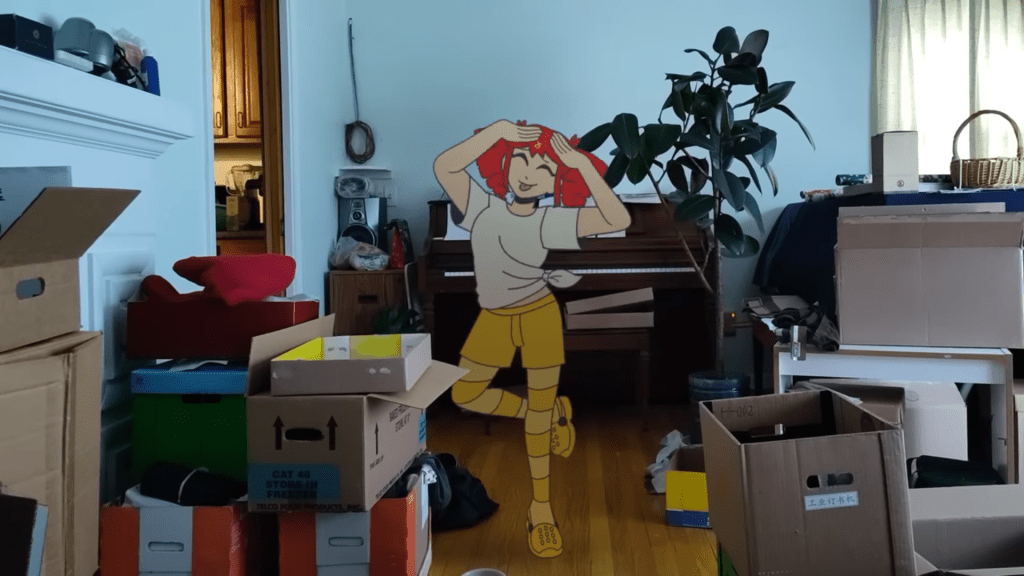
A still from the “BIRDBRAIN” music video.
Because the old (i.e., modernist) mysteries and mystiques of artistry are unavailable to us as anything but pretend-play, I’ve suggested pursuing an embarrassing presence of self (and of limitation, and artifice, and of trying despite it) as a path forward, one that leads to self-conscious embrace of roleplaying rather than deluding or misleading ourselves or audience. An issue that I guess intersects on a few points with the questions we can be asking about identity as an artist and the presence of a discernible self in creative works is the cloud of “AI” or “machine learning” or whatever you want to call it, which I think most principled artists and art consumers understand is, at its most extreme end of minimal human input, basically worthless and actually evil, but which also exists anyway, and so therefore even more deeply principled artists and art consumers might have something to say about like “you can’t put the toothpaste back in the tube, and this is just the new kind of awful thing that you have to be aware of and respond to, and that can mean any number of things, but don’t plug your ears or demand that you get to pretend otherwise.”
No art that is valuable—that is, no art that is sufficiently pockmarked and fingerprinted by signs of its own creation—can be existentially threatened in any way by automated processes; machines will only reveal new dimensions of art’s value and virtue, as they have done for all of history. This is not, I should specify, in any sense a defense of AI or other technology as an instrument of Drano-ing the media production-to-profit pipelines. All I mean is that for anyone serious about making things, or serious about the things others make, the reasons why we are serious can only be made more apparent through this process.
Do you remember in the 2000s and early 10s when people who loved thinking about how good David Gilmour was at playing guitar for real would maybe quip with regard to Kanye West et al that a MacBook wasn’t an instrument? And obviously, the answer is “Who gives a fuck?” because if an artist makes something distinctive and new and singular with whatever methods that has clear intent and is demonstrably ensouled, and is responding to and drawing responses from the broader culture it belongs to, then that’s all the factors you can use to judge a creation. And so the point is that technology and circumstances just change and change, and it’s not good that AI is wrecking the Earth for basically no value added, and it’s not good to harvest rare earth minerals to make MacBooks for people to run ProTools or Ableton on, or even to make paint pigments. Practically, the scale of these things is different, and you can justify one versus others per your own axioms, but where you personally draw the line is sort of arbitrary, even if there definitely should be a line theoretically. But in the era of no good precedents, what can you do but have fun with the world you’re given?
Vocaloid is one fun bit of creative technology that’s trickled up from the Hell of Market Incentive, which isn’t really AI except for the newest version, which kind of is, I guess? It’s called “Vocaloid:AI” and I lack the hardline knowledge to tell you how much that is for marketing versus actually descriptive of the tech. As it’s currently used, “AI” is a misnomer anyhow, so lets not quibble unless there’s a good reason. Anyways, Vocaloid exists somewhere on this spectrum of creative technology, where it basically functions like a digital synthesizer in terms of actually making music with it, but it is also supposed to simulate an actual singing voice (at least in some cases). In the most popular uses, Vocaloid is used to make distinct digital voices, attributed to anime avatars like in the cases of Hatsune Miku and ANRI.
But also Vocaloid in general, and Jamie Paige’s Constant Companions in specific, alludes somewhat to the same fantasy that “AI” technology does: the moment where the artifice becomes life instead of just like it. The drive to this singularity, or the question of it’s being possible, is like foundational to all Do Androids Dream / Blade Runner descended fiction, which has gotta be a big portion of all sci-fi since
Vocaloid is novel and cute, but, like any creative technology (from natural clay to the MacBook) is really kind of nothing but potential energy, waiting and waiting for someone to earnestly, as Jamie Paige so plainly puts it, meet that technology in the middle: to love it in a way that can’t be falsified, and that looks at first disconcerting or embarrassing. Constant Companions is the release of some of this energy toward immense catharsis. In the phrasing and expression of the pre-chorus on the opening track, “Dyad,” the weight of years in company with the Machine crashes down. In the first moment, Paige herself bellows, fraught and trembling, as only an actual person can be,
It’s a repetition every day
Just waiting on the words to say
God, I’m desperate to hear your voicе
I wish I even had a damn choice
‘Causе when I stare across the gap between our hearts
I wanna meet you in the middle!
Just after responds the voice she’s desperate to hear, the perfect and reliable Vocaloid tones of ANRI and SOLARIA, entreating Paige and the audience to “dream together,” to give in and forget what makes them different from us, to stop denying that just because it’s all pretend we can’t have real feelings about art since thats the whole damn point, is to coax ourselves into being vulnerable and available to each other. This tension, the trepidation and sensitivity to exposing and meaning things about ourselves, inherent to good creative work, is present throughout the album, right from these first moments. Following Dyad, Not Quite There takes a more cautious stance, depicting the difficulty and frustration in attempting to access this state of emotional presence, either in creative work or interpersonal relationships. Not by accident, this is the song where Paige’s own vocals are most exposed, front-and-center, with Vocaloid used only for the outro.
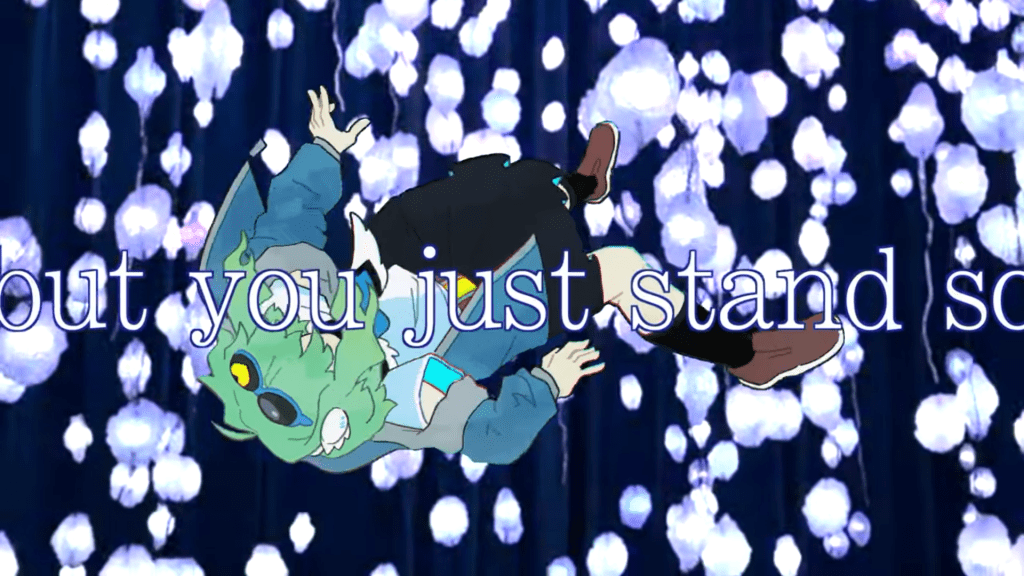
A still from the “I Wish That I Could Fall” music video.
In contrast, the next several songs are sung entirely by Vocaloids, as if to demonstrate that only through this layer of abstraction can certain feelings be genuinely expressed. “I Wish That I Could Fall,” for perfect example, expresses a deep desire to be in touch with another soul, even to the point of servitude, to abandon ego and be totally unafraid to be hurt. But this all has to be said by Vocaloid GUMI, it has to be ascribed to an avatar, and so a second-order expression paradoxically becomes the necessary vehicle for a sincere emotional vulnerability.
Paige resumes singing duties again in the second half of the album, most significantly on the hinge-point ninth track, “Object of Affection.” This track is ostensibly an analogy for the experience of being transgender, described in terms of the song’s protagonist being made into an automaton and, in part because of this, eventually regaining free will. There is the obvious connection here to the form of Vocaloid music, where Paige, in a years-long reckoning with Vocaloid, has been able to literally voice her feelings through these female avatars. And so on this track, the significance of Vocaloid in particular to contemporary expression and identity formation, and that Paige personally can sing in a duet with them, becomes apparent. The track crescendos around this final verse, for the first couple lines sung alongside a Vocaloid, but finished by Paige alone:
Perfect little packages, wrapped up in contradiction
Metal moves organically, a sick and twisted fiction
But maybe what you’re missing is that twisted point of view
The outline of your autumn, cast in cadmium-colored hues
No holding up to scrutiny, impossibly obtuse
So come and join the artifice, we’ve left a spot for you
I swear it on my honor
This doll will make it true
Here is a willingness to sit in, as she puts it, the contradictions of identity and self: to own that we (not just Vocaloids, not just people struggling with gender dysphoria, not just artists, but anyone who is capable of hearing a song like a mirror are constructions and contingencies, and to say that is worthwhile still, and the ability to acknowledge this is our virtue).
The final two songs are the complete synthesis and resolution of these aforementioned “contradictions.” “My Darling, My Companion” is another duet between Paige and a couple of Vocaloids, Kasane Teto, and GUMI, speaking to each other as each other, just as in the opening track, but this time also speaking in admiration and reassurance, posing Vocaloid or the act of creation itself as Paige’s companion in self-actualizing, with the uniformity and rigidity and artificality of Vocaloid presented as a steadying and comforting presence. As GUMI periodically calls out, “My darling, I’m a constant,” Paige declares her intent moving forward: “Learn to call myself mine.”
Finally, “Machine Love” has Kasane Teto singing, from the other side, about her longing to be a real person. Here, Paige fully inhabits the role of the character just as the character inhabits her. It’s either like Pinocchio-descended empathy (“Do you feel the things I feel,” “I am definite and real”) or Her in reverse, but this is, with no small consequence, grounded in something actual to the point it’s barely a metaphor. And that’s maybe the highlight of the album is the confidence in dispensing with talking around or dressing up or making less cringey any of this. To give in to your own fantasy as an artist does not suggest a lack of awareness of the fantasy. Constant Companions understands the condition of artistry and selfhood for real, which is that they are both pretend and no less significant for it.
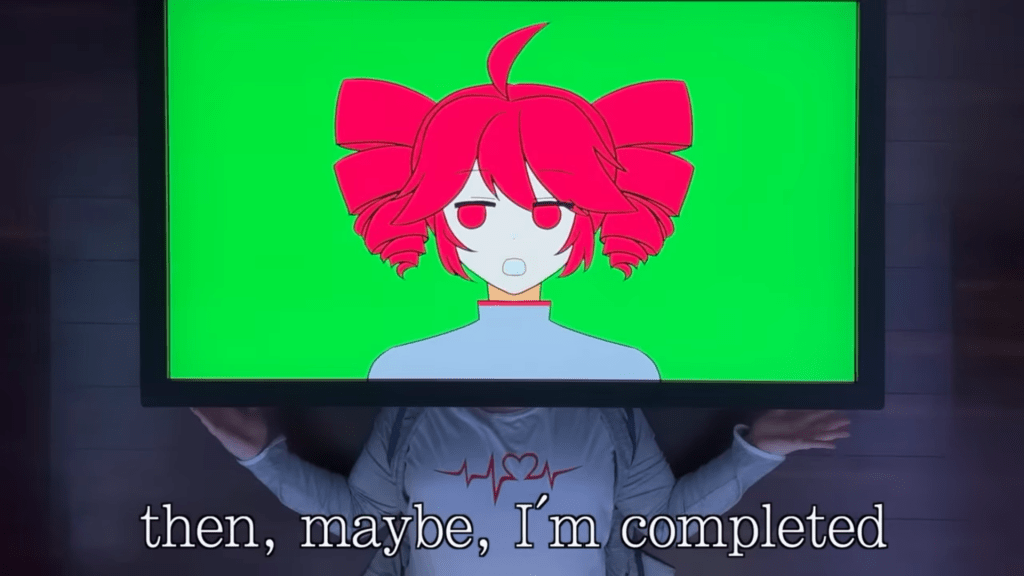
A still from the “Machine Love” music video.
 Proper Left
Leave a comment